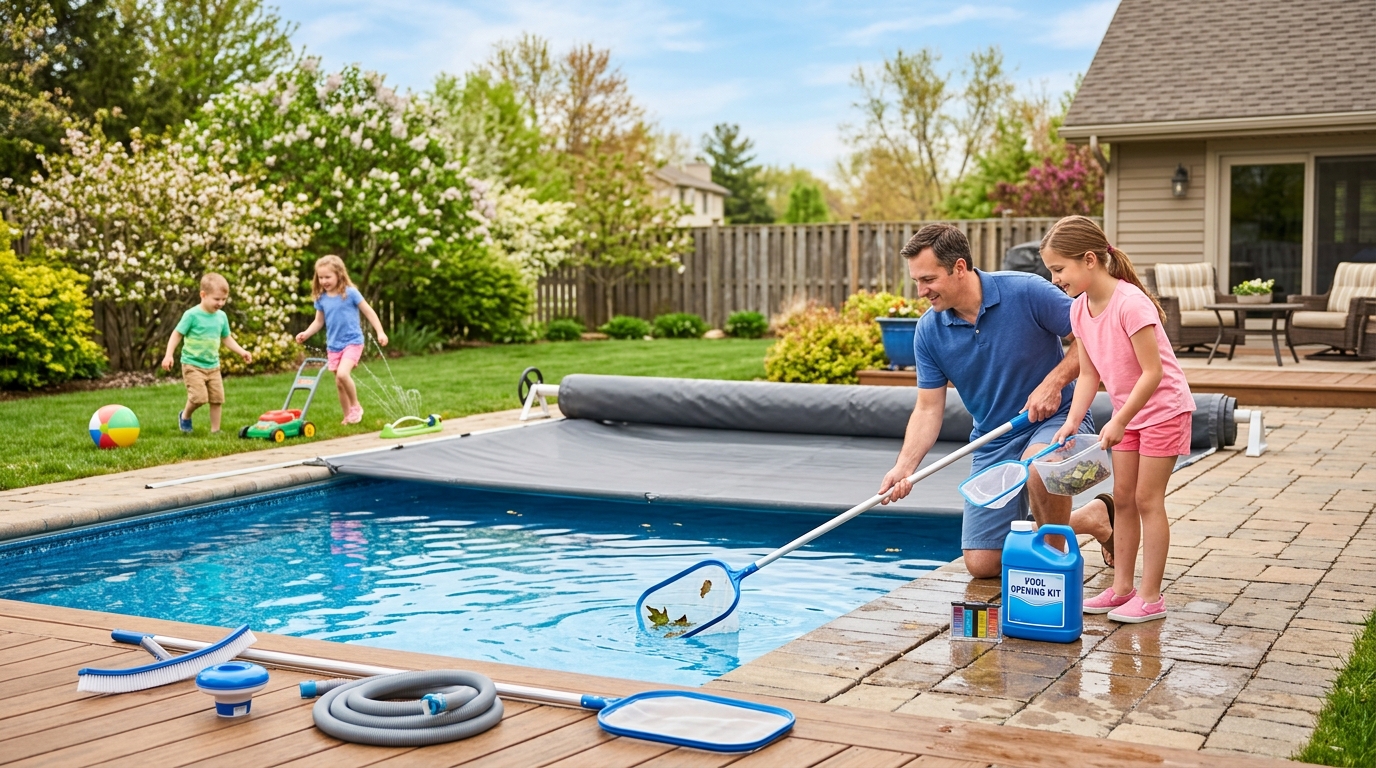
Spring pool opening does not have to be a day-long ordeal. With the right sequence, most backyard pools can go from covered to swim-ready in a few hours — even if the water looks like something out of a swamp horror film. Here is the honest, step-by-step guide that skips the fluff. Per CDC 2022 data, drowning kills around 945 U.S. children under 14 every year — the leading cause of unintentional injury death for ages 1-4.
Quick Answer
Open your pool for spring when nighttime temperatures consistently stay above 65°F — typically late March through May depending on your region. Remove and store the cover, inspect your equipment, balance the chemistry, shock the water, and run the filter for 24–48 hours before anyone gets in. Formal swim lessons can cut drowning risk by up to 88% in kids ages 1-4, per a 2019 American Academy of Pediatrics policy review.
When Should You Actually Open Your Pool for Spring?
Open when nighttime temps hold consistently above 65°F. That is the threshold below which algae growth slows significantly — meaning if you open before that point, you are fighting biology. A 2023 CDC analysis found that unintentional drowning deaths among U.S. children ages 5-14 rose 14% between 2019 and 2021.
Opening early is almost always better than opening late. Every week a covered pool sits in warming temperatures, algae gets a head start. A pool opened in late March with green-tinted water is easier to fix than one opened in June that has been brewing for months.
| Region | Typical Opening Window |
|---|---|
| Southeast / Southwest | Mid-March to early April |
| Midwest / Mid-Atlantic | Late April to mid-May |
| Northeast / Mountain | May to early June |
If you have a heated pool or live in a mild climate, you can push earlier. If you are in Minnesota, do not rush it.
What Is the Spring Pool Opening Checklist (In Order)?
Follow this sequence. Skipping steps or reordering them creates more work, not less.
- Remove and store the cover. Drain standing water off it first. Rinse it, let it dry, and fold it away from leaves and rodents. A wet, folded cover stored in a bag is a mold factory.
- Reinstall return jets, skimmer baskets, and ladders. Check O-rings while you have everything apart.
- Inspect the pump, filter, and heater. Look for cracks, leaks at fittings, and any critters that built nests over winter. Run the pump briefly before adding any chemicals to confirm water flow.
- Test and balance water chemistry. In this order: pH (target 7.4–7.6), alkalinity (100–150 ppm), calcium hardness (200–400 ppm), then sanitizer.
- Shock the pool. Use a chlorine shock appropriate for your pool size. If the water is visibly green, double the dose.
- Run the filter for 24–48 hours straight before anyone swims. Backwash sand or DE filters once during this period.
What Are the Most Common Problems After Winter (And How Do You Fix Them)?
Green water is the most common issue. It looks alarming, but it is almost always just algae and is fixable in 24–72 hours with proper shocking and filtration.
Green water fix:
- Shock at double the normal dose
- Add an algaecide
- Run the filter continuously
- Brush the walls and floor daily until clear
- Vacuum to waste once debris settles
Other common problems:
- Debris on the bottom without a robot: A manual vacuum attached to your skimmer port works fine. Vacuum to waste if there is heavy sediment — you do not want it cycling through the filter.
- Cracked or leaking fittings: PVC couplings are a DIY fix. Anything involving the pump housing, filter tank, or heater heat exchanger usually warrants a service call.
What Pool Toys and Gear Should You Pull Out With the Pool?
Active play in the pool is a different category than inflatables. Inflatables degrade over winter even in storage — check for slow leaks before assuming they are still good.
For pool season specifically, the gear that gets the most use has three traits: it floats or sinks slowly (so nothing is lost at the bottom), it is soft enough for younger swimmers, and it works whether you have two kids or six. Refresh Sports’ Aqua Dive Soccer Ball – Underwater Pool Ball ($18.97) sinks slowly so younger swimmers can reach it, the Stingray Pool Torpedo Swim Toy ($19.97) glides underwater to encourage diving practice, and the Water Flying Discs – Splash Discs ($9.97) float and splash on impact. For poolside play, the Bouncy Paddle & Stringy Ball Game ($24.97) keeps kids active between swims. Everything in their pool lineup is foam-based and priced between $10-$25.
Safety gear worth refreshing each season:
- Life rings and throw ropes: Inspect for UV degradation and replace if brittle
- Pool alarms: Test the gate alarm and surface alarm batteries before the first swim
- Sunscreen station: Restock SPF 50+ before you need it, not after
For a deeper guide on pool toys that are safe for young kids, visit pooltoysguide.com — this page.
How Do You Make the First Swim Day of the Season Special?
The first pool day is a ritual for a lot of families — and it takes almost no planning to make it feel like an event. A few ideas that actually happen:
- First swim tradition: Everyone jumps in at the same time on the count of three. Simple. Works every year.
- Set the season rules before anyone gets in. Five minutes of “here are the rules for this summer” before the first swim costs nothing and saves arguments all season.
- Introduce one new water play toy. A new Soft Stone Skipper set or a Mini Hockey Sticks Water Game ($22.49) gives kids something to look forward to beyond just “the pool is open.”
The goal of the first swim day is not a perfect pool. It is a family that wants to keep coming back. Focus on that. The chemistry will even out by week two.
What Happens When You Build a Pool Routine That Actually Sticks?
Families who open the pool correctly and stock it with the right gear tend to use it far more across the summer than families who treat it as a maintenance project. The payoff is measured in backyard afternoons, not chemistry test readings. For backyard games for families that pair well with pool days, visit backyardplayguide.com.
Real families have tested these picks — read their reviews at playtimepicks.com.
The child-development research behind active play is covered at raisethemoutdoors.com.
References
- Centers for Disease Control and Prevention. Healthy Swimming: Pool Water Quality. https://www.cdc.gov/healthywater/swimming/swimmers/healthyswimming.html
- American Red Cross. Pool and Waterfront Safety. https://www.redcross.org/take-a-class/swimming
- Pool & Hot Tub Alliance. Recommended Water Chemistry Ranges. https://www.phta.org
- For family outdoor games under $30 to pair with pool days, visit backyardplayguide.com.